More Information - Less Waste
Onboard Recycling:
Air Canada manages a domestic onboard recycling program, where newspapers, magazines, plastic bottles, aluminum cans and other beverage containers are recycled at select stations in Canada.
Due to strict regulations mandated by the Canadian Food Inspection Agency (CFIA) through the International Waste Directive, Air Canada along with other transport carriers, are not permitted to recycle from international destinations due to the risks of contamination from foreign food and plant-born vectors.
In addition, influenced by the above regulations, recycling is only available at select Canadian hubs, where adequate segregation from international waste is possible. Newspapers, magazines, plastic bottles, aluminum cans and other beverage containers onboard our domestic flights are collected by in-flight service and recycled in programs managed by caterers and airport authorities.
Office and Facility Recycling
In 2018, Air Canada introduced a centralized recycling program in its offices and facilities. Deskside garbage bins were eliminated and larger receptacles in common areas were installed providing employees access to recycle common items such as plastics, paper, and organics. Work is underway to expand the program to any remaining or new office or facility areas built. Air Canada also regularly recycles bulk waste from its operational facilities. Additional recycling programs for a range of items including wood, metal, plastic film and other items enhance existing programs in these facilities.
Air Canada participates in end producer responsibility programs in multiple provinces for paper and packaging products (PPP). Air Canada and its subsidiaries including Aeroplan and Air Canada Vacations are covered under this program.
In 2021, Air Canada began reporting to electronics extended producer responsibility (EPR) programs in Canada for headsets sold and distributed on domestic flights. This program was formalized in 2022 and Air Canada now reports to provinces with EPR requirements.
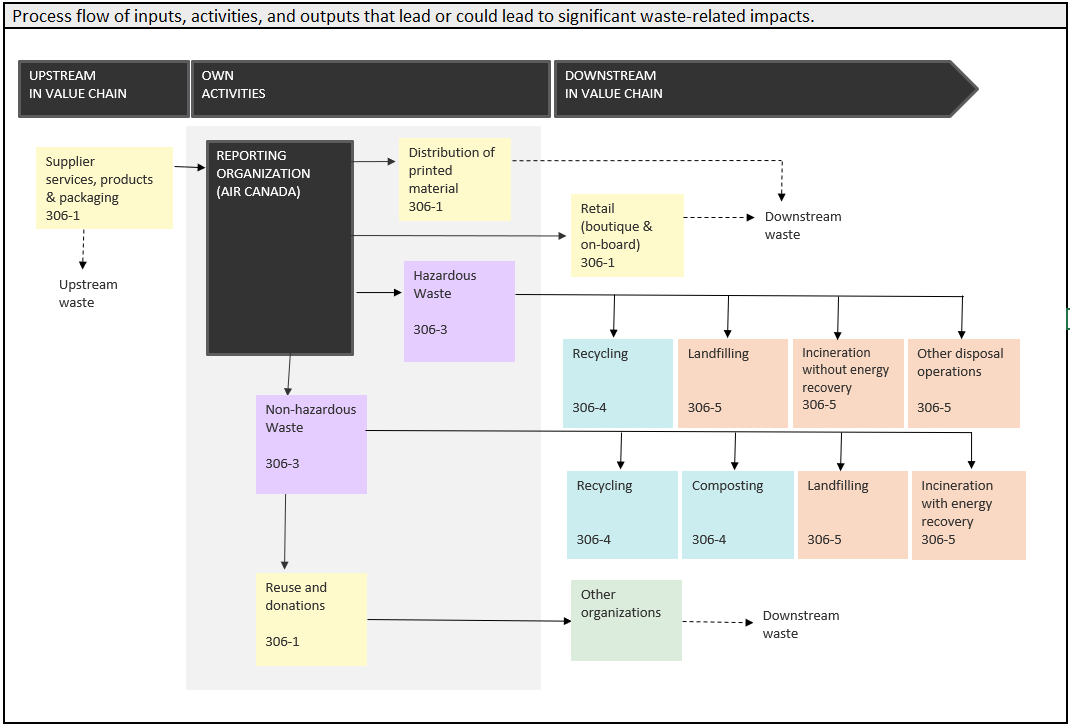
Upstream Inputs
Air Canada is a service-based company and therefore does not manufacture goods and products. Air Canada does, however, purchase services, products, and packaging from suppliers for use and resale. General supplier categories include catering and amenities, aircraft and facility maintenance, office supplies, uniform apparel, and travel goods and accessories. Examples of inputs acquired through suppliers include all meals and products provided during on-board service, maintenance products and equipment such as spare parts, office supplies such as furniture and IT equipment, and branded items such as uniforms.
Waste generated upstream is generated by third-party suppliers providing services and or goods for Air Canada. For example, catering providing prepared meals or companies who provide aircraft parts. This includes packaging, by-product food waste, plastics, cardboard, paper, e-waste, and scrap metals. While the waste generated upstream is not directly managed by Air Canada, the company seeks to influence waste prevention at the source through material selection, procurement decisions, and operational practices. Given Air Canada’s limited influence over manufacturing processes, its efforts are primarily focused on optimizing internal operations and day-to-day workflows to avoid the use of unnecessary materials and reduce waste generation before it occurs.
Own Activities
Air Canada activities that generate non-hazardous and hazardous waste include cargo operations, ground support equipment (GSE), aircraft maintenance, real estate management of offices and facilities, in flight customer service, and retail.
Waste generated from Air Canada activities include non-hazardous and hazardous waste. Non-hazardous waste includes organics, plastics, wood, cardboard, paper, e-waste, scrap metals, textiles, glass, and mixed waste. Hazardous waste includes flammable liquids, oily solids, batteries, corrosives, solvents, chemicals, degreasers, antifreeze, waste fuels, wastewater and sludge. Air Canada manages the waste generated, both hazardous and non-hazardous, from its own activities through contract waste haulers. International on-board waste generated is not monitored and has not been quantified by Air Canada because these wastes are co-mingled with other operator waste at third party-controlled airports and disposal is regulated by the Canadian Food and Inspection Agency (CFIA) under the International Waste Directive (IWD).
Downstream Outputs
Indirect outputs are generated through activities and include the distribution and retail of branded goods, accessories and their packaging acquired through suppliers. Air Canada also has a robust donation program, where gently used items are given to partner organizations for reuse and upcycling.
Waste generated downstream is the result of distribution and retail of branded products on-board, online and in retail locations. This primarily includes paper and packaging products, plastic, and e-waste. In addition, items donated to other organizations are also eventually disposed of downstream. These items include textiles, plastics, and e-waste.
Hazardous waste in offices and facilities is managed by contacting designated waste vendors. During contract negotiations, these vendors are required to disclose their certificate of Approval, Approval to Operate and Operating permit, where applicable, and disposal processes for each location at which they operate. Risk assessments and compliance performance of vendors are reviewed prior to the contract award. In addition, any past environmental issues are reviewed and discussed with vendors, focusing on the implementation of corrective actions, satisfactory compliance resolution and the authorization to proceed with contract is received by the General Compliance Officer of the Law Branch.
The hazardous waste data for offices and facilities is gathered by contacting designated hazardous waste vendors. Reports are compiled on an annual basis and scanned for abnormalities. The non-hazardous waste data for offices and facilities is collected by the designated building management company, other data is collected by the receipt of reports from companies that fall outside the designated contract. These reports are collected on an annual, monthly, and case-by-case basis. The non-hazardous waste data for onboard is collected by conducting waste audits of select flights and applying totals to annual flight data. All data is inputted into an internal dashboard to track overall diversion rates and annual trends throughout the year. International onboard waste is not monitored and has not been quantified by Air Canada because all waste is co-mingled at the airport level. Disposal is regulated by the Canadian Food and Inspection Agency (CFIA) under the International Waste Directive (IWD). International waste must be disposed of in a designated landfill or incineration site. As such, there are currently no waste diversion opportunities available (i.e., recycling and composting) for waste arriving in Canada from abroad.
Non-hazardous waste in offices and facilities is managed by the designated building management company and a handful of companies that fall outside the designated contract. Non-hazardous onboard waste is managed by the designated catering company and local airport. These are regularly audited by the Canada Border Services Agency (CBSA) to ensure disposal of domestic waste is carried out in line with the International Waste Directive. This includes the requirement that domestic waste be properly segregated from international waste.