



/
Carry-on baggage
Carry-on baggage
What you pack matters. Find out what qualifies as a carry‑on, personal item, what you can bring, and size limits so you can travel with ease.
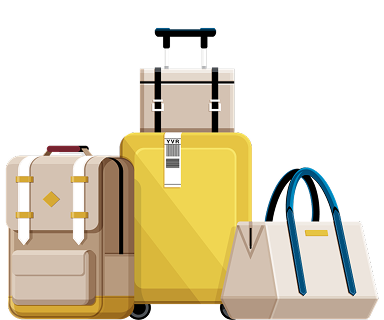
Economy Basic fares purchased on or after January 3, 2025, allow for only one (1) personal item on board when travelling on some itineraries. Find out more.
Standard carry-on policy
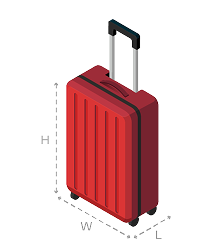
Standard item
Maximum dimensions (D x W x H):
23 x 40 x 55 cm/9 x 15.5 x 21.5 in
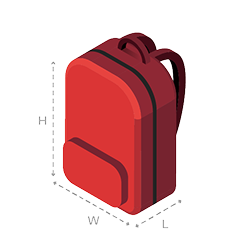
Personal item
Maximum dimensions (D x W x H):
33 x 43 x 16 cm/13 x 17 x 6 in
- Maximum dimensions include wheels and handles.
- No weight limit applies to carry-on baggage, but it must be light enough that you can store it in the overhead bin without assistance.
- If you’re travelling with an infant on your lap, you can bring 1 additional standard article for your child’s belongings such as a diaper bag.
- All carry-on baggage rules are strictly enforced. If your bags don’t respect maximum sizes, they’ll need to be checked. Additional checked baggage charges may apply.
To ensure your carry-on bag will fit on board, we use automated carry-on baggage sizers at pre-security and/or pre-boarding. Find out more about our automated baggage sizers.
If you're connecting onward to an international destination on an Economy Basic fare, your ticket allows you to bring one (1) standard carry-on bag and one (1) personal item on board.
Star Alliance Gold members travelling across two or more-member carriers are entitled to two carry-on bags. Please refer to the dimensions above for Air Canada flights.
If you’re travelling with another airline partner, you may be subject to the baggage policy and other rules of the airline operating the first flight in your itinerary.
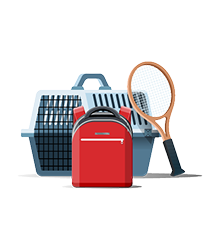
Standard and personal items
Some examples of standard or personal items you can bring on board include:
- Carry-on bags such as roller bags, backpacks, briefcases, or laptops
- Cats or small dogs travelling in an approved carrier (fees and approvals required)
- Cameras, consular bags, or diplomatic bags
- Garment bags
- Sports racquets (e.g. tennis, squash, badminton)
- Small musical instruments
- Airport or duty-free purchases
Motorized or riding luggage (e.g. Modobag) is prohibited as either carry-on or checked baggage. If you require mobility assistance at the airport, please contact Air Canada Accessibility Services.
Find out more about restricted and prohibited items.
Smart bags, or bags that have built-in charging, location tracking or other battery-powered technology are allowed as carry-on baggage, provided they meet the carry-on baggage size restrictions. On smaller aircraft where carry-on bags must be placed in the cargo hold, you’ll need to remove the battery and bring it into the cabin with you.
Find out more about travelling with a smart bag.
The following Anker power banks pose a fire hazard and are prohibited on board:
- Anker Power Bank A1647
- Anker Zolo Power Bank A1681
- Anker Zolo Power Bank A1689
For more information on this recall and for safe handling advice, visit the Government of Canada website.
Some electronic devices are allowed on board with restricted use:
- Wireless handheld devices (Smart phones, cellphones, including cellphones with MP3 player or build-in camera, iPads, tablets, VRs, etc.)
- Personal entertainment devices (MP3, iPods, portable games, radio receivers, video cameras)
- Bluetooth headsets.
- Satellite receivers (e.g. hand-held global positioning systems)
- Laptops:
- Cannot be stowed in seat back pockets, as these are not designed to sustain the weight of a laptop and may be damaged over time.
- Electric shavers
- "Noise busters" (electronic noise cancelling devices)
You may be asked to turn on your electronic device at the security check.
The use of the following electronic devices is strictly prohibited on board:
- Radio transmitters or radio-controlled equipment/toys
- Printers, computer peripheral devices or laser pointers
These items must be properly and adequately packed in your checked baggage.
For more on electronics, go to our Restricted and Prohibited Items page, or to the Canadian Air Transport Security Authority (CATSA) website.
Medication
Always carry your prescription medication with you on board in your carry-on bag. This is especially important if you’re taking medication for heart disease, diabetes, or seizures.
If you have a severe allergy, you should carry one or more epinephrine auto-injectors such as an EpiPen® (as you would under any other circumstance).
For flights departing from France, passengers with disabilities or medical conditions may be asked by the screening officer at security checkpoints to present a medical certificate or prescriptions to facilitate the screening process.
Insulin
Insulin does not generally require refrigeration, but if you’d like to keep your medication cold, please bring a small cooler, as the cabin crew is not able to look after medication on board. If available, extra ice may be provided as needed.
Medical or mobility devices
The following items are always allowed, in addition to your carry-on allowance:
- Mobility aids (e.g. braces, cane, crutches, walker, communication devices such as an augmentative and alternate communication (AAC) device) or other special need items
- Tools of any size which are required by a passenger with special needs who is travelling with a mobility aid
- Battery-powered medical equipment (such as CPAP and sleep apnea devices) and Personal Oxygen Concentrators
- Medication in its original, labelled container
- Syringes or hypodermic needles for personal medical use (e.g. EpiPen®), provided the needle guards are intact, and that they are accompanied by the prescription medication with a printed label identifying the medication name and the issuing medical office or pharmacy.
- Container carrying life sustaining items
Important:
Unforeseen situations may require flights within Canada to divert to a U.S. airport, where arriving in possession of cannabis is illegal.
If you’re refused entry into a country because you have cannabis in your possession, you alone will be responsible for the consequences, including for payment of your return trip home.
The Canadian Border and Services Agency recommends that you don’t bring it in, don’t take it out.
Cannabis for recreational use
Although recreational use of cannabis is legal within Canada, it’s illegal to travel across the border and internationally with it.
Medical cannabis
Travel with properly packaged medical cannabis is only permitted within Canada. Flying outside of Canada with medical cannabis is illegal and prohibited by airport authorities.
If you’re travelling with medical cannabis (marijuana), always allow additional time for security screening. Canadian Air Transport Security Authority (CATSA) officers require that you present medical documentation to verify that you are permitted to travel with medical cannabis and will call local authorities to verify the validity of the documents.
For more information on travelling with medical cannabis and other medical items, visit the Canadian Air Transport Security Authority (CATSA) or Government of Canada websites.
Effective August 28, 2026, Air Canada will no longer accept cremated remains in checked baggage. They can, however, continue to be transported in carry-on baggage or via our Air Canada Cargo – AC Compassion service, subject to applicable requirements, including screening by CATSA or equivalent authorities in other countries. Customers may also explore more options with their funeral home.
We understand that travelling with cremated remains is a deeply personal and sensitive experience. Our teams are here to support you every step of the way.
To help ensure a smooth journey, it’s important to be aware that security screening requirements are determined and set by Transport Canada and must be followed by all travellers. These requirements apply to all airlines operating in Canada. To avoid delays at the airport, we recommend reviewing the information below before travelling.
Container requirements
- Use a container made of plastic, wood, or cardboard. Avoid metal or dense materials, as they may not pass security screening.
- You should plan to use a temporary or travel-friendly container when possible.
- Due to differences in thickness, shape and material, some cremation containers are more likely to pass through security screening than others. If the container cannot be clearly screened, it will not be allowed through security.
Security screening
- All cremated remains must go through mandatory security screening.
- Screening officers are not authorized to open the container, even if requested.
- Smaller amounts of cremated remains (less than 350 mL) are more likely to be successfully screened. If the volume exceeds 350 mL, you may need to transport the cremated remains via our Air Canada Cargo – AC Compassion service.
Screening outcomes are determined by CATSA and cannot be guaranteed regardless of baggage or container used. Final decisions cannot be overruled by Air Canada or airline staff.
Documentation
We strongly recommended that you also travel with your loved one’s:
- certificate of cremation
- death certificate
Additional documentation may be required depending on where you’re travelling. Please check with the local consulate or appropriate authorities for your destination before travelling.
If you would prefer not to travel with cremated remains in your carry-on, or if you require alternative arrangements, additional support is available through Air Canada Cargo. Your funeral home may also be able to help arrange other transportation options.
Wedding dresses can be carried on board and stored in the overhead bin provided the garment bag does not exceed maximum carry-on limits.
Please note that although this is an important item, we cannot guarantee space in the cabin.
While specific restrictions apply to the transport of some items, other items cannot be brought onto the plane at all. We’ve provided a partial list on our Restricted and Prohibited Items page.
For a complete list, always refer to the Canadian Air Transport Security Authority (CATSA) website.

Liquids and gels
Liquids and gels in your carry-on bag must be in containers of 100 mL/100 g (3.4 oz) or less.
- If you travel with liquids or gels in containers over 100mL/100g (3.4oz) in your carry-on baggage, these items will be confiscated at the security checkpoint.
- If you plan to purchase liquids at the airport, always do so after you’ve passed the security checkpoint.
- If you have a connecting flight, you’re advised not to purchase liquids or gels in containers over 100 mL/100 g (3.4 oz) within the secure area at the airport or on board the aircraft if you don’t have:
- access to your checked baggage between connecting flights
- room in your checked bag to pack your duty-free purchases before rechecking your bags for your next flight
Please note that you cannot consume your own alcoholic beverages on board.
For detailed information on travel with liquids and gels, please see the Canadian Air Transport Security Authority (CATSA) website.
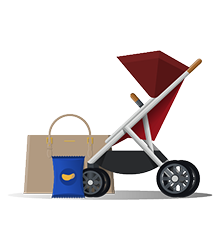
Additional items
Below are examples of other items you can bring on board in addition to your carry-on baggage allowance.
- A coat or other outer garment
- A small purse max. 25 x 30 x 14cm (10 x 12 x 5.5 in)
- Larger purses will be included in your carry-on allowance.
- An infant care item (e.g. diaper bag)
- A stroller - collapsed diameter not exceeding 25.5 cm (10 in) and length not exceeding 92 cm (36 in)
- A child restraint device (if a seat has been purchased for your child)
- Food/snacks to eat on board, wrapped or in a container.
- Please note that you cannot consume your own alcoholic beverages on board.
- Smoking accessories
- One book of matches per passenger
- Butane Bic-type lighters, which are the only type of lighter accepted past U.S. pre-clearance checkpoints for departures from the U.S.
- Electronic cigarettes, nicotine vapes or e-cigarettes, provided they remain stowed and unused in your carry-on bag.
Economy Basic Fares
Air Canada Economy Basic fare tickets purchased on or after January 3, 2025, no longer include carry-on baggage for select destinations.
If you’re travelling on a Basic fare, your ticket allows you to bring one (1) personal item on board when travelling:
- within Canada and to/from the U.S. (including Hawaii and Puerto Rico)
- to/from Mexico, Central America and the Caribbean
All other bags will need to be checked before security, either at a self-serve bag drop location or at a check-in counter. If you’re checking in online or at a kiosk, you’ll need to provide a credit card for pre-authorization of gate handling fees of CA/US $65-$78 (tax inclusive).
Frequently asked questions
Yes, you can bring an additional small purse or bag, provided it is no larger than 25 x 30 x 14cm (10 x 12 x 5.5 in). Larger bags will count towards your carry-on allowance.
See the full list for more information on what items you can bring on board in addition to your carry-on baggage allowance.
On full flights, we may ask customers travelling on fares that include a standard carry-on bag to check their bags voluntarily to save overhead bin space.
Since Economy Basic fares do not include carry-on baggage, checked bag fees still apply.
When you’re travelling on an Economy Basic fare, you can bring one (1) personal item with you on board.
If you're travelling with more bags, you can pay your fee when you check in online or on our mobile app. Then simply print your bag tags at a kiosk when you get to the airport and drop off your bags at our check-in counter or at a self-serve bag drop-off location.
Additional links
Contact Air Canada Reservations or Air Canada Cargo
Find essential information on the Canadian Air Transport Security Authority (CATSA) website