
- Pregnancy, children and travel
- Booking, Ticketing and Seating
- Bassinets and Strollers
- Child Restraint Devices
Travelling with your children on Air Canada is simple! Here are some useful tips for a seamless travel experience:
Early boarding
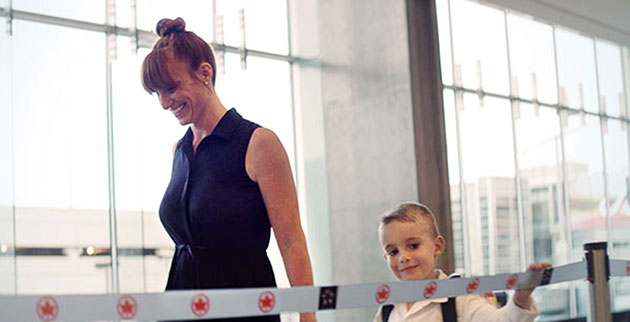
Flying with kids under age 6? Make sure to be at the departure gate by the time indicated on your boarding pass to take advantage of pre-boarding between zones 2 and 3. This means extra time to store belongings and settle in.

Family seating
We’ll make sure you and your kids under age 14 sit close to each other at no extra charge1. We’ll assign generic seats close together for you and your children before check-in.
1 A fee may apply if you decide to change the free standard seat assignment provided, or if you select Preferred Seats.
Because families should stick together!
When you book your flight online, indicate that you are travelling with children, and we will assign generic seats in proximity to each other for you and your children before check-in. You can then review your seat assignment by going to My Bookings.
For Air Canada Vacations bookings, go to the “View & Print Itinerary” link.
If you book directly with Air Canada Reservations, be sure to tell our agents that you’re travelling with a child under the age of 14, and they’ll make sure you’re seated close together at no extra charge.
If you did not book your travel via Air Canada directly, you can contact Air Canada Reservations to be seated, or go to My Bookings to review your reservation before check-in and validate your seat assignment.
If we are unable to seat one adult in close proximity to a child, you may contact Air Canada Reservations to change your booking to another flight on which we can provide proximity seating, or cancel your trip, all at no extra charge.
Choosing your own seats
For the best choice in seats, it’s always better to select them when you book your flight. Note that a fee may apply when choosing your seats in advance. A fee may also apply if you decide to change the free standard seat assignment provided, or if you select Preferred Seats.
Pregnancy
If you have an uncomplicated pregnancy and no previous history of premature labour, you may travel by air up to your 36th week on Air Canada, Air Canada Rouge and Air Canada Express. For high-risk pregnancies or if you are 36 weeks or more into your pregnancy, please have your treating healthcare professional complete the Fitness-for-Travel form and send to our Accessibility services desk for medical clearance evaluation.
Additional information including advice on Travel and Pregnancy can be found at Pregnancyinfo.ca.
Breastfeeding and travel
We are happy to support breastfeeding onboard our aircraft, whenever safety permits.
Fun for Kids!
To keep the little ones happy, we offer a variety of cool giveaways on select flights. And don’t forget to check out the “Kids” section on our In-Flight Entertainment , which includes 75 hours of movies and games just for kids.
Goodies*
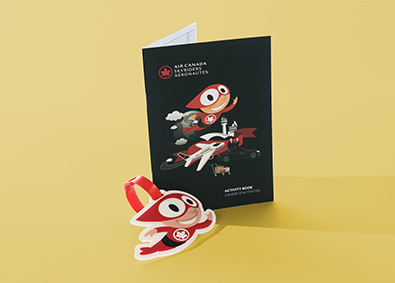
Special Luggage Tag
At the Family Check-in counter, your kids can pick up a special luggage tag. It’s a fun way to add personality to their bags and commemorate a trip.

Activity Books & More
On Air Canada and Air Canada Rouge flights within North America, we offer activity books to keep your kids entertained.
On international flights, your kids can enjoy new fun travel goodies, like a tote bag filled with things young explorers will love, including an activity book, a crayon kit, and more.
* Subject to availability.
Special Services

Meals
Special meals for infants and children are available on all of our international flights and in Air Canada Signature Class, Business Class, Premium Economy and Premium Rouge on all flights. You can order your special meal at time of booking on aircanada.com, or by contacting Air Canada Reservations at least 24 hours prior to departure.
Formula, breast milk, juice and baby food (in small containers) are permitted in carry-on baggage. Because onboard refrigeration may not always be available on all aircraft types, the cabin crew is unable to look after these items on board. We therefore ask that you bring these items in a small cooler to keep them at the desired temperature. If available, extra ice may be provided as needed.
Change tables
All our aircraft - with the exception of a few Canadair (CRJ) regional aircraft - have changing tables in the front or back lavatories.
Identification Requirements
Find out what travel documents your child needs to travel.
Child Welfare and Safety
Safety Regulations
Air Canada is bound by Transport Canada regarding acceptable child restraint devices.
Only approved child restraint devices can be used on board our aircraft.
- Please refer to the “Child Restraint Devices” section at the top of this page for more information.
Infants under the age of two must be lap-held or secured in an approved child restraint device by an adult 16 years of age or older during taxi, take-off, landing, and any time the seatbelt sign is on.
- As the parent or guardian, you may choose whether to lap hold or secure your infant in their child restraint device during those times.
- For safety reasons, Air Canada does recommend the use of a child restraint device for infants.
- As set out in Canadian Aviation Regulations, an adult passenger (16 or older) may only be responsible for one infant during a flight, whether the infant is seated on their lap or in a child restraint device.
For children age 2 or older, the use of a child restraint device is optional and dependent on the manufacturer's guidelines for the device's maximum weight.
- Some child restraint devices are a combination of a child restraint system and a booster seat. To be acceptable for use in the aircraft, the internal harness system must be installed and all child restraint device-labelling requirements must be met. When used as a booster seat, the internal harness system is removed and is not approved for use on board the aircraft.
Air Canada does not provide seat restraint devices for small children or infants.
Please consult the “Child Restraint Devices” section at the top of this page for information on acceptable child restraint devices, exceptions and restrictions, plus checked and carry-on baggage rules.
Your child’s age will determine which booking, seating, and ticketing rules apply.
Please refer to the ‘Pregnancy, children and travel’ section at the top of this page for guidance on how to make sure you and your child are seated close together.
Fares
| Infant (up to age 2) | Child (over age 2) | |
|---|---|---|
| Within Canada |
|
|
| Canada/U.S. |
|
|
| International |
|
|
† The discount on the adult fare does not apply to any taxes, fees, charges and surcharges.
†† The child’s fare applies only to children under age 12. Youngsters age 12 and up will pay the adult fare. If your infant child’s second birthday occurs between the departure and return segments of an international trip, you have the option to pay:
- The full published child's fare for that flight (and be certain to have a confirmed seat both ways), or
- The infant fare on the departure, and the published child's fare on the return. Call Air Canada Reservations to book this option.
Travelling with an infant or child in the Air Canada Signature Class cabin
- With exceptions, child restraint devices are not permitted. Call Air Canada Reservations for details.
- When occupying a Classic or Executive Pod in Air Canada Signature Class, a child age 2 to 7 must be seated directly in front of, directly behind or in an adjacent seat facing the accompanying parent or guardian.
- The child and the accompanying guardian will receive a mandatory briefing on the safety features of the Air Canada Signature Class cabin prior to takeoff.
- Please contact Air Canada Reservations whenever booking travel with young children in Air Canada Signature Class to ensure the availability of appropriate seating.
Bassinets
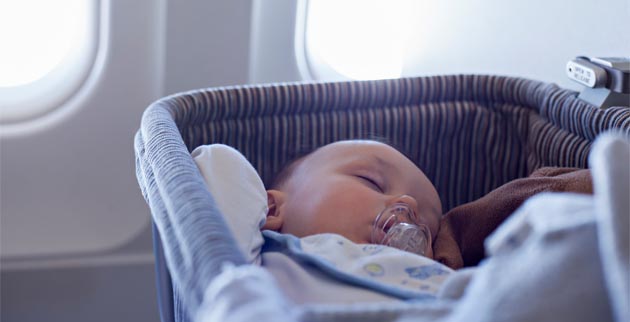
If you're travelling with a young (or small) infant in Economy Class, you may request a bassinet in advance of travel by contacting Air Canada Reservations. However, we are unable to confirm availability until the time of your flight's departure.
- Bassinets are assigned on a first come, first served basis, subject to availability at time of flight departure.
- Bassinets may be provided on the following aircraft:
- Boeing 787-9 (789)
- Boeing 787-8 (788)
- Boeing 777-300ER (77W)
- Boeing 777-200LR (77L)
- Airbus A330 (333)
- For safety reasons:
- Bassinets can be used only for infants weighing less than 12 kg (25 lb) who are unable to sit upright.
- The cabin crew is responsible for installing the bassinet once the seat belt sign has been turned off.
- Please note that bassinets are installed at bulkhead rows where armrests do not lift.
Strollers
You can bring one stroller for each child you are travelling with in addition to your carry-on and checked baggage allowance and regardless of your destination.
Air Canada strongly recommends the use of small collapsible umbrella type strollers.
Small strollers - with a collapsed diameter not exceeding 25.5 cm (10 in) and a length not exceeding 92 cm (36 in) - can be checked free of charge at the baggage counter or at the boarding gate. When accepted at the baggage counter, your stroller is delivered to the arrivals baggage hall at your final destination. When accepted at the boarding gate, it is delivered to you at the aircraft door at every point in your journey.
Large heavy strollers can only be checked at the baggage counter because gate facilities in airports are not designed to accommodate them. Additional baggage fees do not apply. Large strollers are also subject to space limitations, and there is a risk that they cannot be accommodated in the aircraft.
If you're travelling with a collapsible wagon, it should measure less than 25.5 cm (10 in) in diameter and 92 cm (36 in) in length while collapsed.
You can bring a collapsible wagon free of charge at the baggage counter or at your boarding gate. When checked at the gate, your wagon will be delivered to you at the aircraft door at every point in your journey.

When using an approved child restraint device for travel with an infant or child, it is the parent’s or guardian’s responsibility to be familiar with:
- The device manufacturer’s installation instructions
- The method of securing and releasing their infant or child from the device
- The method of quickly releasing their infant or child from the restraint in the event of an evacuation
Approved child restraint systems
| Child Restraint Device | Transport Canada Regulation |
|---|---|
AmSafe Child Aviation Restraint System (CARES™)Adjustable belt-and-buckle flight harness that attaches directly to the aircraft seatbelt. Designed for children weighing between 10 to 20 kg (22 to 44 lb), whose height is 100 cm (40 in) or less and who are capable of sitting upright. |
Must be used within the limitations specified by the manufacturer (as indicated on the label), and must display the following:
Cannot be installed in Air Canada Signature Class cabin. Is not easily compatible with Bombardier Dash 8-300 (DH3) and Dash 8-100 (DH1) aircraft. Contact Air Canada Reservations for more information. |
AmSafe (CARES™) device for taller individualsAdjustable belt-and-buckle flight harness that attaches directly to the aircraft seatbelt. Designed for taller individuals with special needs who are over 137 cm (54 in.) and up to 183 cm (72 in.) in height. |
Must be used within the limitations specified by the manufacturer (as indicated on the label), and must display the same label and part number as the regular CARES™ device (please see above). Important: Contact Air Canada Accessibility Service if the use of this larger type of AmSafe (CARES™) device is required for travel. |
Devices manufactured in Canada |
Must bear the National Safety Mark, which indicates the number of the standard(s) to which the restraint device conforms, i.e. CMVSS 213 (child restraint device) or 213.1 for (infant restraint device). |
Devices manufactured to U.S. standards |
Must bear both of the following labels:
|
Devices manufactured to Australia/New Zealand (AS/NZS) standards |
Must bear both of the following:
|
Devices manufactured to United Nations (UN) – Economic Commission for Europe (ECE) standards |
Must bear both of the following labels:
|
Other foreign-built car seats |
Must adhere to Transport Canada regulations. |
Prohibited Child Restraint Devices
- Booster seats: a booster seat (or cushion) is defined as a removable device for use in a vehicle for the purpose of seating in an elevated position a person whose mass is 18 kg (40 lb.) or more. It is designed to be used with an automobile lap and shoulder belt and is therefore not approved for use in an aircraft.
- Belly loops and vests or harness type devices.
- Hammock-type seats, such as Fly LegsUp, Flyebaby.
- Little Cargo® seats (notwithstanding any claims from manufacturers that they are approved for use in aircraft).
The following devices are not approved for use as a restraint device during taxi, take-off and landing, or at anytime the seat belt sign is illuminated; they can, however, be used for comfort at all other times during the flight.
- Infant sling/wrap carriers similar to Snugli™ or Baby Bjorn™ are accepted in addition to the infant's carry-on allowance if required for use on board the aircraft. The parent or guardian will have to remove their infant from the carrier every time the seat belt sign is illuminated.
- Infant beds similar to Flyaway Kids Bed, BedBox cannot block access to the aisle and must be stowed when the seat belt is illuminated.
Other important rules, regulations and exceptions
Air Canada Signature Class
- For safety reasons, child restraint devices are not permitted in the Air Canada Signature Class cabin. Some exceptions apply. Contact Air Canada Reservations for details.
- Infants under age 2 can travel in the Air Canada Signature Class cabin but must be held in the adult's lap.
- When occupying a Classic or Executive Pod in Air Canada Signature Class, a child age 2 to 11 must be seated directly in front of, directly behind or in an adjacent seat facing the accompanying parent or guardian.
- CARES™ child restraint devices cannot be installed in the Air Canada Signature Class cabin.
- All approved devices must fit between the armrests of the seat. They must be installed according to the directions on the device and secured using the seat belt fitted on the aircraft seat.
- Weight restrictions are specified on all child restraint devices.
- Rear-facing devices are generally restricted to babies weighing less than 9 kg (20 lb.).
- Forward-facing devices are generally restricted to babies or children weighing 9 to fewer than 30 kg (20 to 65 lb).
- A combination system (i.e. both a child restraint system and a booster cushion) is accepted for in-flight use provided it is used as a child restraint system and the internal harness system is installed, and all labelling requirements are met. It must not be used in-flight as a booster cushion*, with the internal harness system removed.
- Pouch-type infant carriers (e.g. Snugli™, Baby Hawk or Ergo) are allowed for use on Air Canada flights, except during take-off, landing, taxiing on the runway and at any time the seat belt sign is on.
- A restraint device that cannot be restrained due to size, design, or damage must be transported as checked baggage, as it cannot be stowed under the seats or in the overhead bins.
- Please contact your travel agent or Air Canada Reservations for more information and possible exceptions to these rules (e.g. medical reasons).
* A booster seat (or cushion) is defined as a removable device for use in a vehicle for the purpose of seating in an elevated position a person whose mass is 18 kg (40 lb.) or more. It is designed to be used with an automobile lap and shoulder belt and is therefore not approved for use in an aircraft.
Checked baggage rules
- If you’re travelling with an infant or child up to the age of 11, you can check a car or booster seat free of charge in addition to your regular baggage allowance. Just a reminder that the car or booster seat can’t contain any additional items such as clothing or other belongings.
- Take a moment to write your name and address on the car or booster seat with an indelible (Sharpie-type) marker.
- If you’re travelling with a child age 2 or older and plan on bringing a car seat, we recommend using it on board instead of checking it in.
Carry-on baggage rules
- A child restraint device may only be accepted as carry-on in addition to the infant's child carry-on allowance provided a seat has been purchased for the infant/child.
- Infant sling/wrap carriers like Snugli™ or Baby Bjorn™ are accepted in addition to the infant's carry-on allowance if required for use on board the aircraft. These carriers are not approved for use as a "restraint device" and may not be used during taxi, take-off, and landing, or at any time the seat belt sign is illuminated. The parent or guardian will have to remove their infant from the carrier every time the seat belt sign is illuminated.